
Virgin Active looks toward a fitter future

The increasing prioritisation of health and wellness provides a durable long-term structural tailwind for the estimated US$120 billion global health and fitness industry. We unpack the opportunities for Virgin Active as it looks set to benefit from its premium positioning, improving member engagement and disciplined growth strategy.
The extensive club portfolio
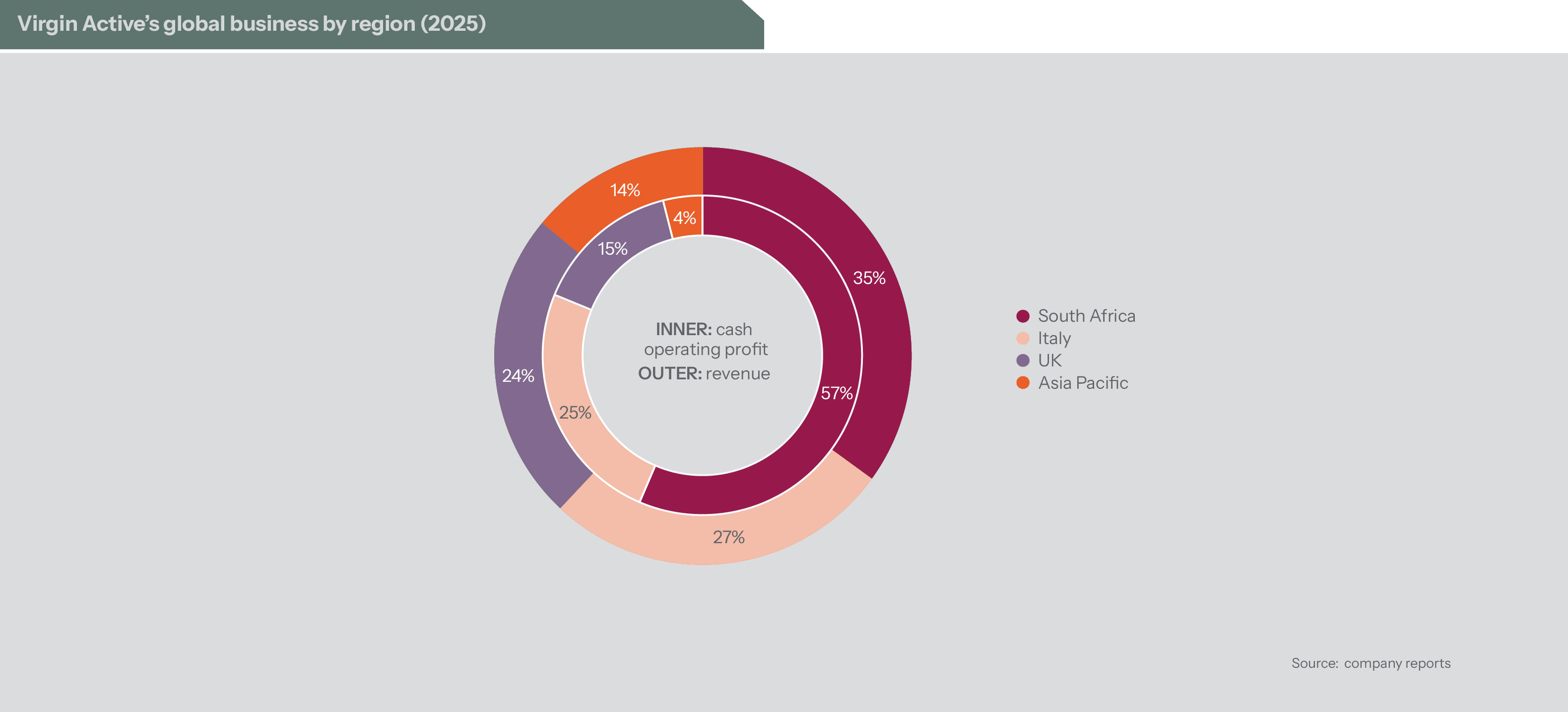
Virgin Active was founded in the UK in 1999 and has grown to 226 clubs operating across four continents. South Africa remains the largest region by revenue (35%) and profits (57%), with approximately 625 000 active members across 128 clubs serving multiple target markets – charted below.
Virgin Active tailors its clubs to local preferences in each region. In Italy (27% of revenue), where it is the largest health and fitness club operator, its 31 clubs cater for members who typically exercise later in the day and value a lengthy post-work experience. Clubs therefore feature spacious, well-equipped changing rooms with massage pools, saunas and spa facilities. The UK (24% of revenue) consists of premium city-centre clubs serving professional commuters, complemented by larger clubs in suburban residential areas.
The Southeast Asian market features high population densities and an underpenetrated fitness sector, offering scope for future membership growth. Currently, Virgin Active has 23 clubs across Australia, Thailand and Singapore. In these markets, group exercise classes are a key attraction, and the gym serves as much as a social destination as it does a place to exercise.
Strong medium-term growth outlook
Government-imposed mobility restrictions during COVID had a severe impact on the health and fitness industry. Clubs across multiple territories were forced to close completely for an extended period, which meant the business generated zero revenue during this time, while still bearing many overhead costs. When they were allowed to reopen, it was under strict capacity limits. This caused active memberships to plummet, with revenue and cash flows following suit. Virgin Active responded decisively by reducing operating costs, minimising cash outflows through disciplined capital expenditure (ie essential maintenance only) and deferring rental payments.
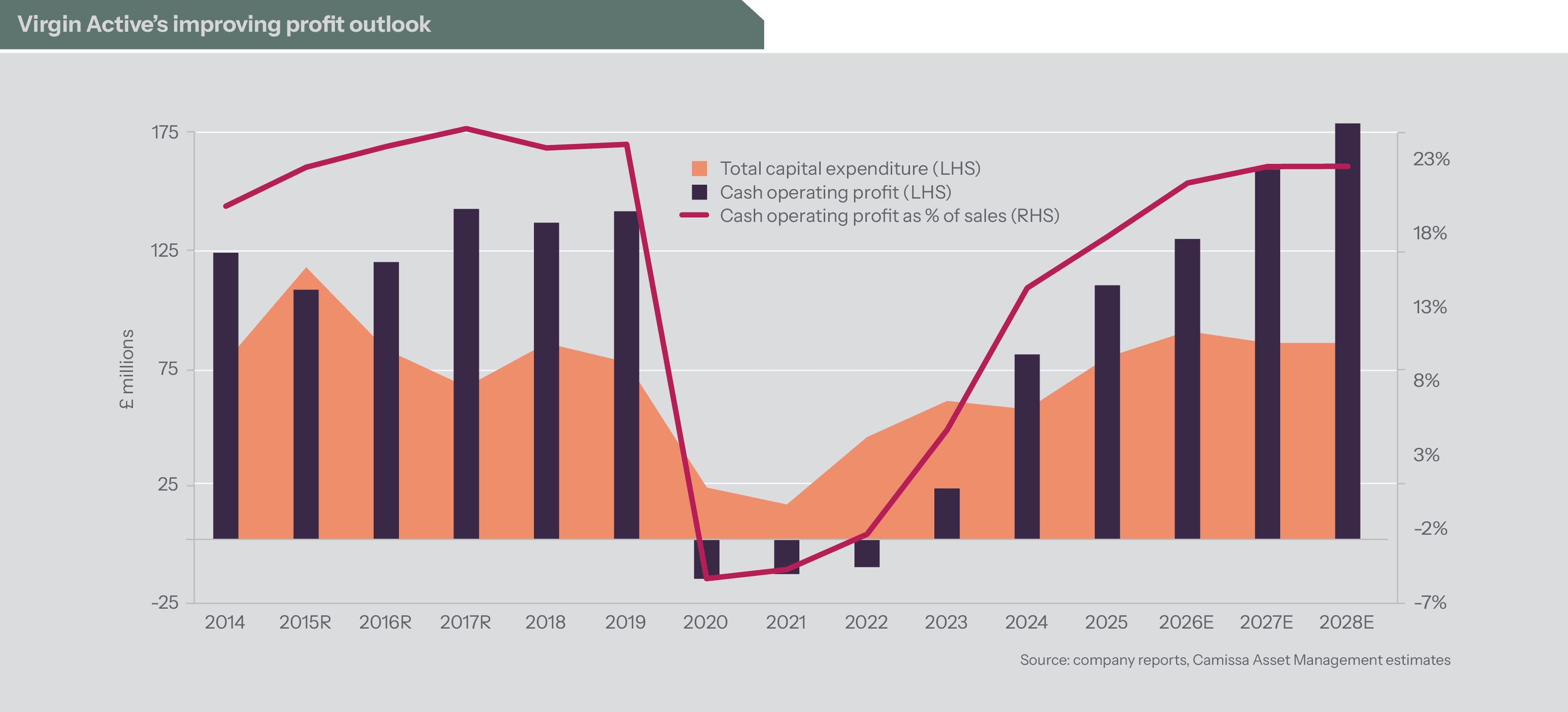
As trading conditions normalised, membership levels recovered and profitability rebounded strongly. Virgin Active is now well-positioned to benefit from numerous growth initiatives, having emerged from the pandemic with a leaner cost base, a more disciplined capital allocation approach and a renewed focus on member engagement. As illustrated below, management is targeting medium-term profits of £180-£200 million, resulting from continued membership growth, new club openings and refurbishments, and higher member spend. They are doing this with a careful focus on considered capital expenditure.
New leadership, enhanced strategy
In March 2022, Dean Kowarski took the reins as the new global CEO of Virgin Active. He founded the Real Food Group, a collection of casual, health-focused restaurant chains, incorporating over 200 stores operating under the Kauai (acquired 2015) and Nu brands. The Real Food Group was acquired by Virgin Active when Dean joined the group. Under his leadership, Virgin Active’s strategy has evolved from a traditional fitness offering toward a broader, more holistic wellness proposition, with a particular focus on higher income members via premium club formats.
An economically strong business model
Virgin Active’s business generates recurring cash revenues from monthly memberships and requires relatively low capital investment, therefore delivering consistently high returns to shareholders. Returns on capital vary by market and depend largely on the extent to which landlords fund initial club fit-out costs, with these costs typically recovered through higher rental payments over the lease term, rather than being funded by Virgin Active.
Landlords in South Africa and Italy bear most of the initial capital costs under a “hot shell” model, resulting in exceptionally high returns on invested capital (ROIC) for Virgin Active on its new clubs, of 84% and 38% respectively (see below). New club returns are more modest in the UK, at around 15%, where Virgin Active funds the full cost of opening new clubs.

Member engagement is a key focus
Central to Virgin Active’s strategy is improving member engagement, which management believes will translate into higher member retention. The current member attrition rate is higher than general global averages (30-40%), at approximately 45% per year. Put differently, the company must replace almost half of its membership base every 12 months to maintain overall membership levels. This is a costly exercise given the marketing spend and sales commissions required to attract new members.
Reducing membership attrition therefore represents a significant earnings enhancement opportunity for Virgin Active, as higher retention enables the active membership base to grow at a significantly lower customer acquisition cost.
Members who attend clubs regularly and engage more deeply with the Virgin Active ecosystem are far more likely to renew their memberships. To strengthen engagement and build long-lasting member relationships, the company is:
- Investing in gym refurbishments - enhancing the member experience through upgraded equipment, new class offerings (such as reformer pilates, Hyrox and the Virgin Active Padel Club) and expanded recovery facilities (including ice baths and saunas). Refurbished clubs also offer improved social and co-working spaces where possible, encouraging members to spend more time in clubs, increasing engagement and strengthening community-led retention.
- Focusing on hospitality - delivering a consistently high-quality experience across all areas of the club, from front-of-house service and personal trainers to the food offering.
- Expanding digital platforms - particularly in the Virgin Active app. Member data is used to personalise interactions and deepen engagement. The app also enables the global rollout of Virgin Active’s loyalty programme, incentivising activity and encouraging more frequent use.
Proven platform, ready for growth
Virgin Active has a healthy pipeline of new clubs over the next few years, that will increase its existing base by about 15%. These are all focused on the premium segment of the market, with 4 new clubs planned in South Africa, 1 in Chelsea in the UK and 23 earmarked for Italy, currently representing the largest growth opportunity. Although it already has a leading market position in Italy, management sees significant scope to grow materially by opening clubs in attractive suburban locations using its proven hot shell model.
Virgin Active also plans to expand its premium wellness club concept into other European markets, having identified opportunities across seven key cities. The region’s premium fitness and health club market remains fragmented and relatively underdeveloped, providing scope to replicate the success of its proven UK and Italy club model, through targeted expansion.
Club refurbishments offer the highest returns
Virgin Active has invested significantly in upgrading its existing club estate, predominantly in South Africa and the UK (the Italian clubs are relatively new). Following refurbishment, membership fees are increased to reflect the club’s enhancements and the improved member experience. This strategy has proven successful, with higher membership yields offsetting acceptable levels of attrition and, in some cases, membership growth. The Point club in Cape Town is a good example. Following a R130 million refurbishment, membership declined by just 4% despite a significant increase in headline pricing, while club profitability significantly improved.
Major refurbishment capital expenditure has generated very strong ROIC of around 125% in South Africa and Italy, and approximately 60% in the UK (charted above). Beyond these attractive financial returns, refurbished clubs are a key driver of member engagement, leading to stronger retention, higher profitably and better long-term returns for shareholders. There remains a healthy pipeline of high-return refurbishment opportunities in South Africa and the UK. Virgin Active intends to continue allocating capital to this strategy.
Premium growth opportunity
Virgin Active has emerged from COVID as a stronger and more focused business, with a clear strategy centred on improving member engagement, investing in high-return club refurbishments and expanding its premium club footprint. We expect these initiatives to deliver improving profits for shareholders in the years ahead. Our client portfolios have exposure through JSE-listed Brait, an investment holding company that has a controlling stake in Virgin Active.