
Siemens Healthineers: patient-led innovation

Siemens Healthineers (Healthineers) is a market-leading medical technology company, with roots stretching back to 1896, when it manufactured its first X-ray tubes. German professor Wilhelm Röntgen, who discovered X-rays in 1895, praised the quality of its tubes - an early indicator of the company’s innovation capability.
More than a century later, Healthineers operates in over 70 countries, holds upwards of 15 000 patents and employs 74 000 people. 13 000 of these employees are dedicated to research and development (R&D), outnumbering those in manufacturing. We explore how continuous innovation and strong commercial execution have positioned the business as a leading global med-tech company.
Global business
There are more than 700 000 Healthineers systems installed across hospitals and healthcare providers globally, with key markets including the US, Europe and China. Healthineers has built its business on pioneering breakthroughs in medical technology and it ranks among the top spenders on R&D relative to competitors.
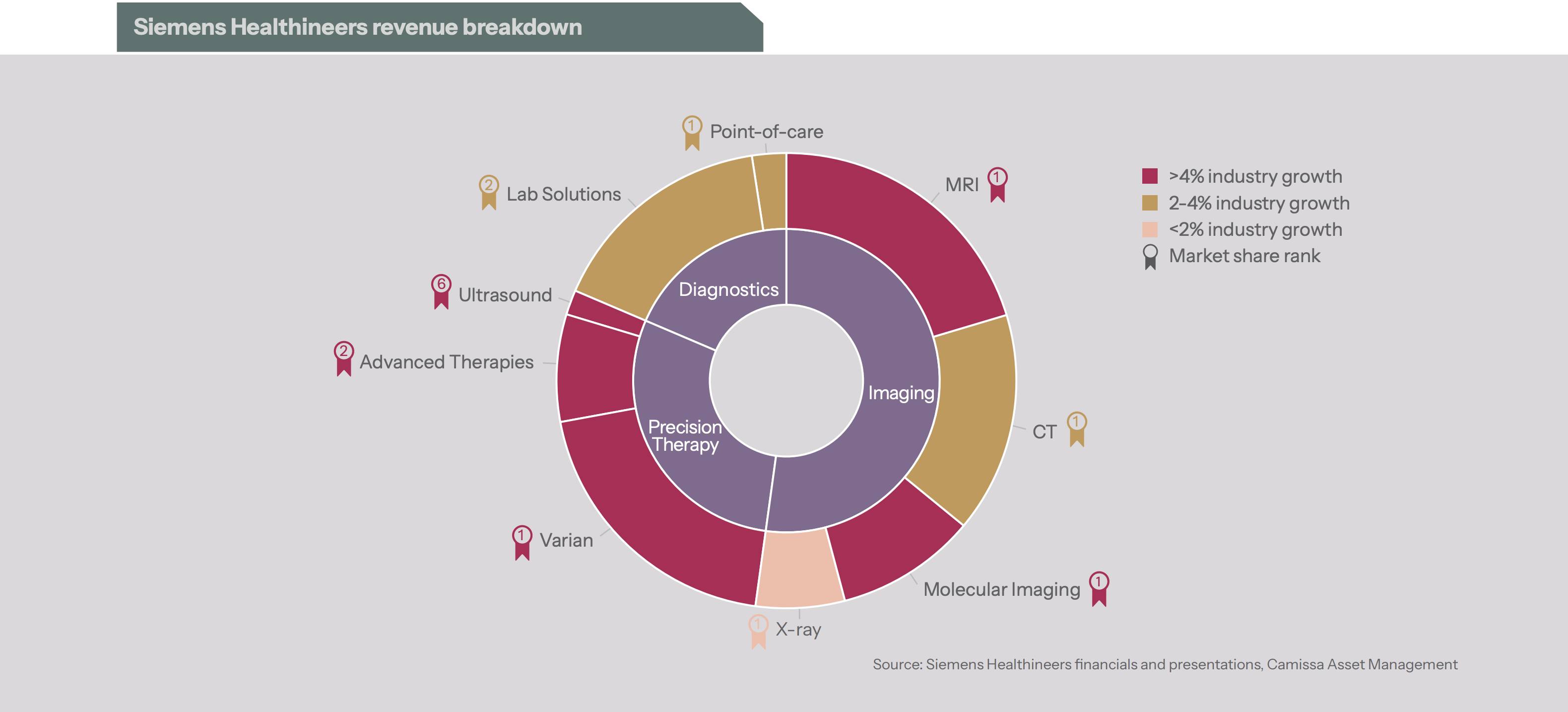
As charted below, the business operates across three core divisions: Imaging builds diagnostic imaging systems including X-rays, computed tomography (CT), molecular imaging (MI) and magnetic resonance imaging (MRI). Diagnostics manufactures medical laboratory devices and testing kits. Precision Therapy comprises:
- Varian, that offers a broad portfolio of radiotherapy technologies and clinical professional services supporting oncology departments in hospitals and clinics.
- Advanced Therapies, which supplies equipment used in image-guided, minimally invasive procedures across cardiology, neurology and oncology, with angiography systems and mobile C-arms as its core products.
- Ultrasound, designs and manufactures ultrasound systems.
Widening the competitive gap through innovation
Since 2018, Healthineers' Imaging business has steadily expanded its revenue market share (up from 31% to 38%). This momentum is driven by continuous innovations, its robust installed base of 160 000 imaging systems and a valuable recurring revenue model. About 50% of Imaging revenues are from recurring sources, primarily after-sales service and software contracts with hospitals and clinics.
Ongoing R&D investment enables these advancements, supporting first-to-market product launches, premium pricing and industry-leading margins. 75% of revenue is now generated from Healthineers' recent product innovations.
Within the Imaging division, MRI, CT and MI are among the fastest growing modalities. They are expected to surpass the broader global imaging market's 4-6% per annum medium-term growth. Demand is fuelled mainly by ageing populations, which increase the need for chronic disease diagnosis and treatment. Nearly two thirds of developing countries lack adequate imaging infrastructure. Efforts to upgrade healthcare systems in these regions are expected to further boost demand.
The PCCT system
In 2021, the company introduced the world’s first Photon Counting CT (PCCT) system, the most significant CT advancement in 14 years. The illustration below highlights the differences between PCCT and standard CT systems.
Compared to standard CT scanners, photon counting CT systems detect and measure the energy of individual X-ray photons directly, eliminating the need for a scintillator1. This helps produce clearer images during AI reconstruction, enables better tissue differentiation and reduces radiation exposure for patients.
Overall, PCCT technology improves hospital productivity and clinical confidence. Healthineers expects this to become the standard of care, with all CT scanners sold by 2040 incorporating this technology. Current barriers to adoption include the high price point, as PCCT systems cost three to five times more than standard CTs. They are working on releasing more affordable options with fewer features, which will aid accessibility, particularly in developing countries.
1 Aggregates x-ray photons and converts them into visible light for processing by the photodiode into pixels for image reconstruction.

The molecular imaging growth engine
MI is expected to become the fastest-growing global modality within Imaging. It enables clinicians to see how diseases behave inside the body, rather than merely to observe organs. Its importance is growing quickly as new targeted drugs rely on these scans to determine who should be treated and to track patient progress. By using small radioactive tracers2 and PET or SPECT scans, doctors can detect disease earlier, choose the right treatment and monitor how well it works.
Relative to competitors, Healthineers is well positioned in this space as, in addition to selling scanners, it runs the largest radiopharmaceutical network in the US, and a growing European footprint supplying the tracers used in these scans. These tracers are high-margin consumables and have a short life (expire within 10 hours), requiring localised manufacturing and timely distribution.
2 These are injected, swallowed or inhaled to diagnose conditions like cancer, heart disease and neurological disorders by highlighting metabolic activity or blood flow in specific tissue.
Varian powers cancer treatment
In 2021, Healthineers bolstered its cancer treatment portfolio by acquiring US-based radiotherapy systems leader, Varian, for $16.4 billion. Varian is roughly twice the size of its Swedish competitor, Elekta - in the global radiotherapy duopoly. Since the acquisition, rising cancer prevalence, enhanced R&D, broader distribution and cross-selling into Healthineers' installed base have strengthened Varian's leadership, with its market share rising from 50 to 60% by 2025.
Varian has consistently led innovations in linear accelerators (linacs)3, setting industry standards in adaptive radiotherapy. Early and reliable innovations established Varian as the preferred partner for cancer centres aiming for highly efficient workflows. The company strengthened its offering by building a fully integrated oncology ecosystem - linacs, treatment-planning software (Eclipse), oncology information systems (ARIA) and later imaging. This broad portfolio offering has created high switching costs. Once hospitals adopt Varian as their standard, switching to another vendor entails significant operational and financial risk. Looking ahead, rising numbers of cancer cases and hospitals' reluctance to change providers are expected to reinforce Varian's market leadership and premium position.
3 They deliver precise beams of X-rays or electrons to tumours, killing cancer cells, while minimising damage to healthy surrounding tissue.
Diagnostics shakes off long-COVID
The Diagnostics division manufactures handheld diagnostic devices and the Atellica platform, comprising modular automated blood and urine testing systems. Medical testing laboratories are the primary target market, where the company operates a "razor-and-blades" business model, with approximately 90% of sales revenue derived from high-margin, recurring consumables rather than laboratory hardware.
The division benefited from exceptionally strong antigen test kit sales and profits during and shortly after the COVID pandemic. It was later forced to restructure after a sharp drop in COVID antigen test kit demand, which substantially affected profitability. A new divisional management team and targeted investments in the Atellica platform have supported its turnaround. Despite early issues, including higher ramp-up and installation costs at client laboratories, management has remained committed to Atellica's long-term economics. The Diagnostics division has turned a corner, with revenue stabilising and operating profit returning to positive, driven by a shift in the sales mix toward more Atellica sales.
Developing market competition
In developed countries, technological leadership enables premium market positioning. However, in budget-conscious developing countries, competitive dynamics are very different. Expansion into markets like China is a key growth area for Healthineers, although it has proven challenging.
Healthineers, along with competitors, have established local manufacturing and operations to capture Chinese med-tech market growth. Emerging domestic Chinese competitors such as Mindray and United Imaging have scaled rapidly, supported by material investments by local government into the healthcare system via local suppliers. Thus, there has been intensified price competition in mid-tier segments and reduced access to public tenders for foreign suppliers.
Chinese regulation has amplified these challenges, with volume-based procurement driving price reductions, a prolonged anti-corruption campaign delaying hospital purchasing, and growing preference for the cheapest producer of med-tech equipment in public hospitals. Despite this, Healthineers is relatively well positioned. Its strength lies in premium, clinically differentiated technologies and a local-for-local manufacturing footprint, which helps mitigate regulatory risk. This allows the company to defend profitability and compete more effectively than its competitors as the market polarises between low-cost and high-value solutions.
Bright prospects
Siemens Healthineers is a global leader in the med-tech industry. The recovery in Diagnostics highlights discipline and resilient management. Its large and expanding installed base, supported by pioneering technologies and integrated clinical workflow solutions, should continue to generate durable growing cash flows, even in challenging markets such as China. Accordingly, our clients are invested in this market leader.