
Optasia: powering digital credit in Africa

In Sub-Saharan Africa, only one in five adults have access to a conventional bank account, leaving much of the population outside the formal financial system. This creates a major challenge when short-term credit is needed. Optasia addresses this gap by providing the technology that assesses the creditworthiness of unbanked borrowers and connects them with telecom operators and lenders for credit. We unpack how the company enables financial institutions across the continent, highlighting its competitive advantages, growth opportunities and recent investor concerns that have created a unique investment opportunity.
The infrastructure behind digital lending
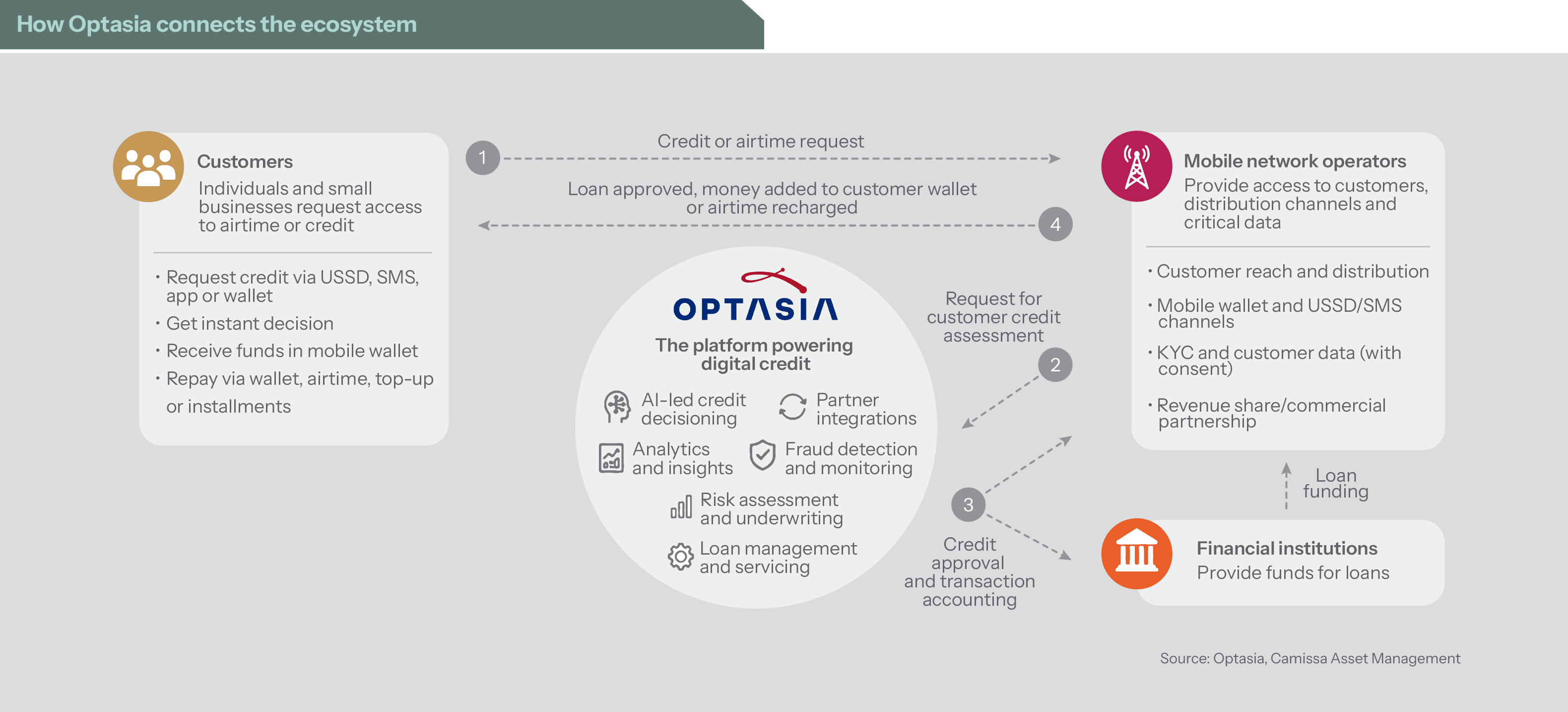
Optasia is a fintech company at the centre of the digital lending ecosystem across Africa and parts of the Middle East and Asia. The company reaches more than 400 million users across 38 countries and processes over a billion credit applications annually. While consumers see the trusted brands of telecom operators like MTN or Vodacom when they borrow, Optasia powers the lending processes behind the scenes - as shown below.
The telecom partner provides customer access, wallet infrastructure, KYC1 data and distribution, while financial institutions provide the lending capital. Optasia contributes the technology, credit underwriting models, analytics and operational capabilities that enable digital lending.
Customers access the service directly from their mobile phones, requesting loans through SMS, USSD menus2, mobile apps or wallet interfaces. This is very accessible and convenient to use: a user dials a short code and requests a small advance, the loan is approved and the customer receives airtime or funds in a mobile wallet within seconds, allowing them to use mobile services or transact almost immediately.
Customers repay outstanding loan balances at any one of thousands of easily accessible informal mobile money agents. The mobile network operator partners provide Optasia with massive existing client bases and decentralised access to them, while the use of smart technology creates a scalable platform with low incremental costs. This makes small-ticket, short-term lending commercially viable in a way traditional banking cannot match.
Competition in this microcredit market in Africa is currently limited, with Optasia and Jumo the main players. Optasia benefits from significantly greater scale given its wider geographic footprint, more diversified partner base and an estimated disbursed loan value around three times that of Jumo. Optasia asserts that their credit scoring capabilities are unmatched.
1 Know Your Customer: identity verification and customer information that financial institutions and regulated service providers collect to comply with anti-money laundering and financial crime regulations.
2 Unstructured Supplementary Service Data menus are interactive text-based menus that let users access services on a mobile phone by dialling a short code.
A high return model
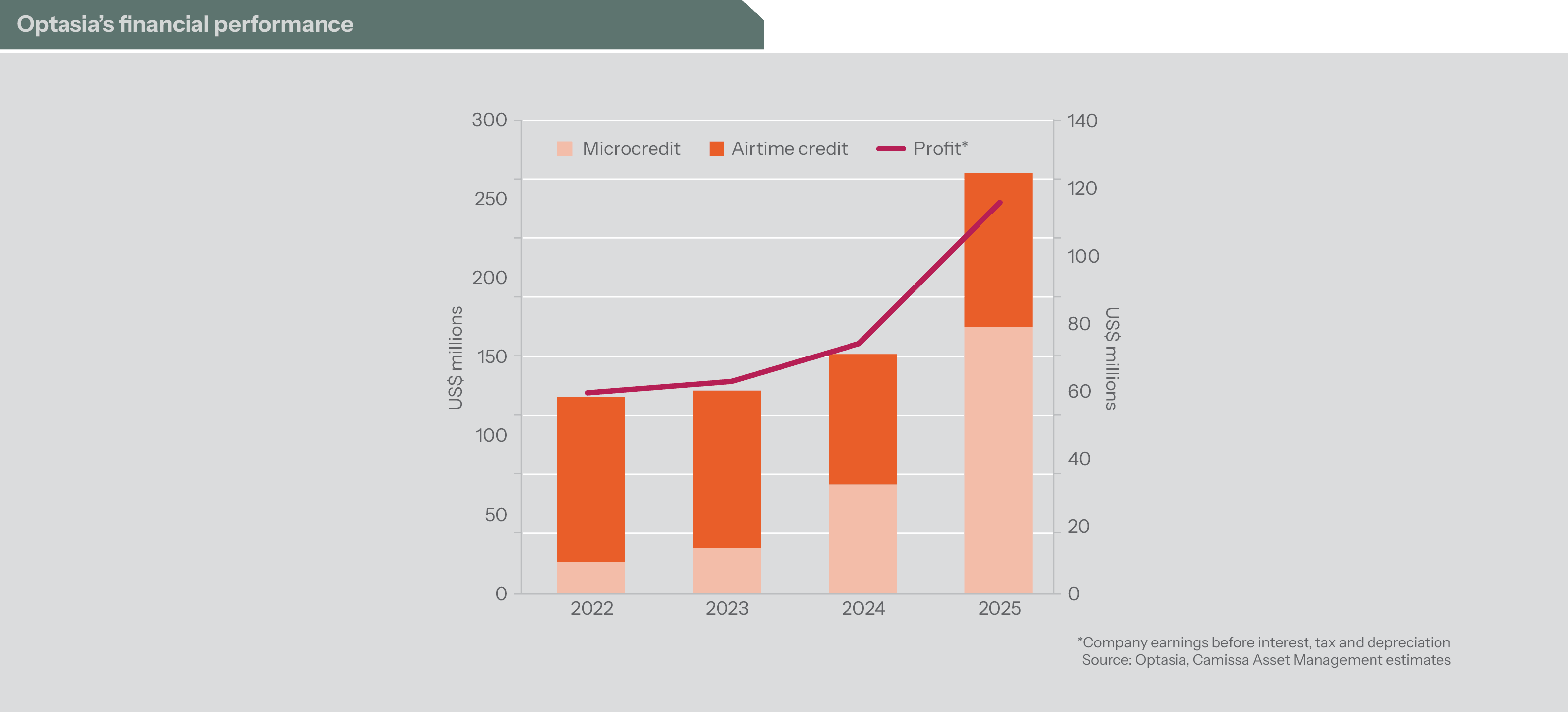
As charted below, the company has delivered strong revenue and profit growth over the past few years, driven primarily by two products: airtime credit and microcredit solutions.
Airtime credit is the older and more established business. It provides very small airtime advances (US$0.25 on average per transaction) when users run out before their next recharge. Repayment occurs automatically when the customer next buys airtime.
Microcredit is the newer and faster-growing business, representing the company’s largest expansion opportunity. These loans average around US$5, with repayment periods of approximately one month. The segment has scaled rapidly, delivering annual revenue growth of more than 100% over the past three years, yet remains in its infancy, having launched only five years ago.
As loan durations are short, Optasia receives repayment feedback quickly and can continually recalibrate lending decisions. If credit conditions deteriorate in a market, the company can rapidly tighten approvals or reduce loan sizes. If conditions improve, it can increase lending just as quickly. This dynamism substantially reduces the risk of large losses related to default or unforeseen credit events and has seen Optasia maintain a default rate of around 1% of disbursed value.
The business model is capital efficient due to the small loan sizes and short repayment periods, which allows capital to be recycled several times a year. This high capital velocity enables the company to serve millions of customers while generating material returns on capital.
Why Optasia has an edge
Optasia’s competitive advantage rests on three reinforcing strengths: proprietary data, sophisticated underwriting models and scale.
Traditional credit bureaus often have little or no usable data on the customers Optasia services as most of these borrowers are informally employed and lack established credit histories. Instead, the company draws on data obtained via its telecom partners and other alternative sources, using machine-learning models that assess credit risk in real time.
The platform analyses unique behavioural signals from the end customer, such as: location data, the types of transactions made, the creditworthiness of the people paid, calling patterns and the frequency of SIM card or mobile phone changes. These data points, among many others, may appear unconventional, but taken together and processed by sophisticated AI models, they reveal patterns strongly correlated with repayment behaviour.
Optasia has access to one of the deepest alternative-credit datasets in developing countries, including the vast amount of customer and repayment data accumulated over the past decade. The business is continually refining and improving its credit models and thereby its underwriting accuracy. This creates a powerful feedback loop: more loans generate more repayment data, which improves model and credit scoring accuracy, allowing the company to further grow the number and size of loans.
A substantial growth runway
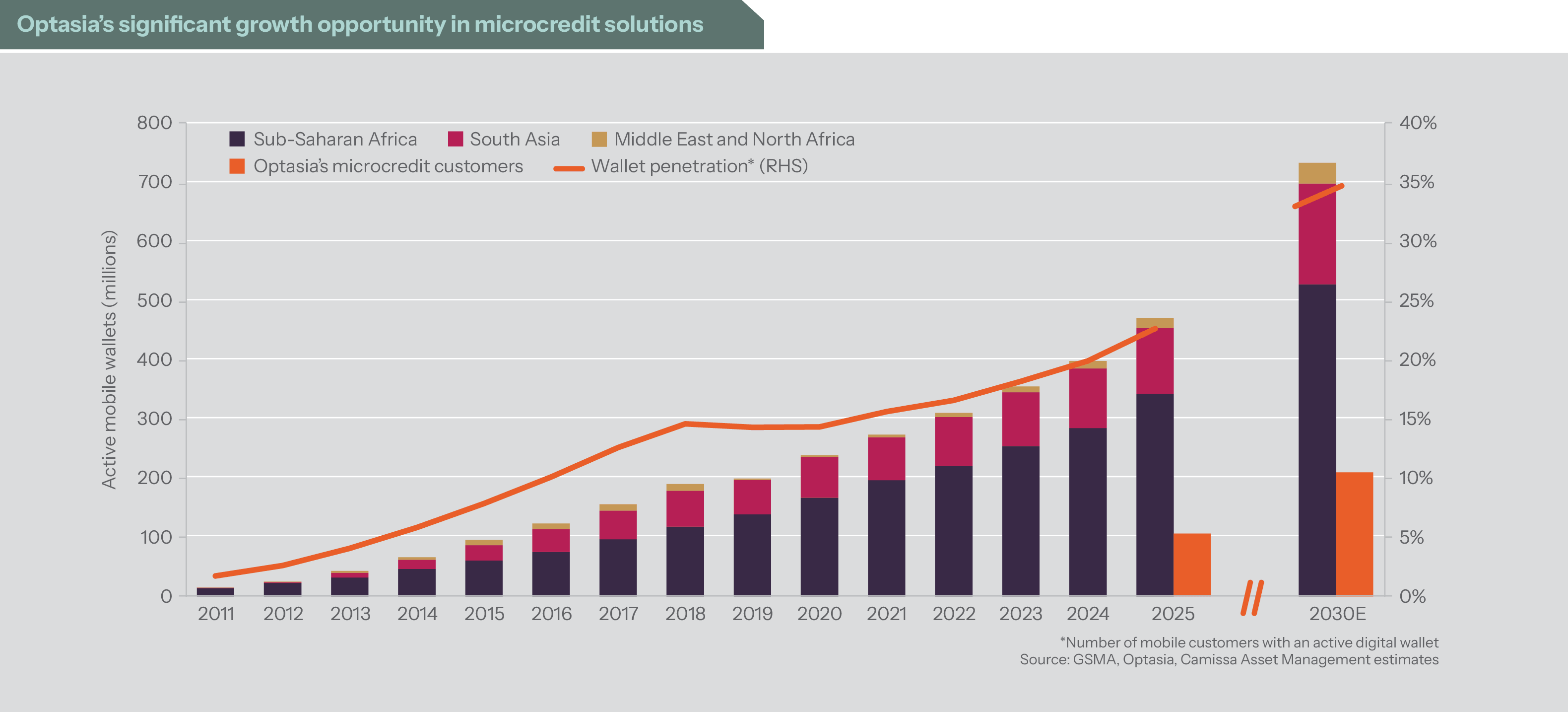
While airtime credit revenue growth is likely to moderate going forward, the opportunity in microcredit solutions is significant due to favourable demographics, rising incomes causing greater demand for credit, increasing mobile penetration and growing mobile wallet adoption.
We estimate that the size of Optasia’s addressable customer opportunity across its existing markets will nearly double over the next five years, as mobile subscribers grow, mobile wallet penetration rises and existing wallet users make more use of the service – indicated below.
The launch of services into new markets and through new mobile network partners provides substantial additional growth opportunities. The company has a pipeline of over 30 new country deployments, representing a future revenue opportunity comparable to its current revenue base.
As income levels rise and Optasia gains deeper insights into customer behaviour, there is also an opportunity to increase average loan sizes. Additionally, product expansion offers another growth lever as Optasia’s infrastructure could support adjacent product offerings such as overdrafts, merchant financing, buy-now-pay-later services and even financing for utilities (eg prepaid electricity).
Concerns clouding the outlook
Digital credit regulation across many developing countries is relatively immature and likely to evolve as the credit industry formalises. Future policy changes could compel the introduction of competitors, cap lending rates, tighten compliance requirements or increase operating costs. While stricter regulation may weigh on future industry profitability and perhaps dampen potential growth, it could also raise barriers to entry, reinforcing the competitive position of established and profitable operators such as Optasia.
Another concern is Optasia’s dependence on large telecom operators who control customer access and distribution. Over time, these partners may seek a greater share of the economics or attempt to bring parts of the lending process in-house. We expect such insourcing to be limited as, to date, Optasia’s moats have proven very difficult to replicate.
A rare opportunity
Optasia has successfully built a differentiated digital credit lending platform that connects mobile operators, funding partners and customers. This has become a critical enabler of financial services in markets historically underserved by traditional banks. Its scale, proprietary underwriting models and low-cost distribution network create meaningful competitive advantages.
Despite regulatory uncertainty and reliance on telecom partners, Optasia operates in a large and rapidly expanding market. Structural tailwinds, including rising mobile wallet adoption, favourable demographics and growing demand for small-ticket digital credit, present a significant long-term growth runway. We believe Optasia’s low share price presents a high expected return opportunity in a company with strong fundamentals, a differentiated competitive position and significant earnings potential.