Fiserv - banking on payments

Behind a morning coffee purchase sits a vast, interconnected network of requests and approvals moving between customers, merchants and banks. Like passengers navigating a busy airport, payments travel across shared infrastructure networks and pass through multiple checkpoints before arriving safely at their destination. Fiserv provides the software and processing infrastructure that helps move payments across several critical touchpoints in the financial system. We examine their entrenched banking relationships and fast-growing merchant acquiring platform and assess the company’s long-term prospects.
Invisible infrastructure behind everyday payments
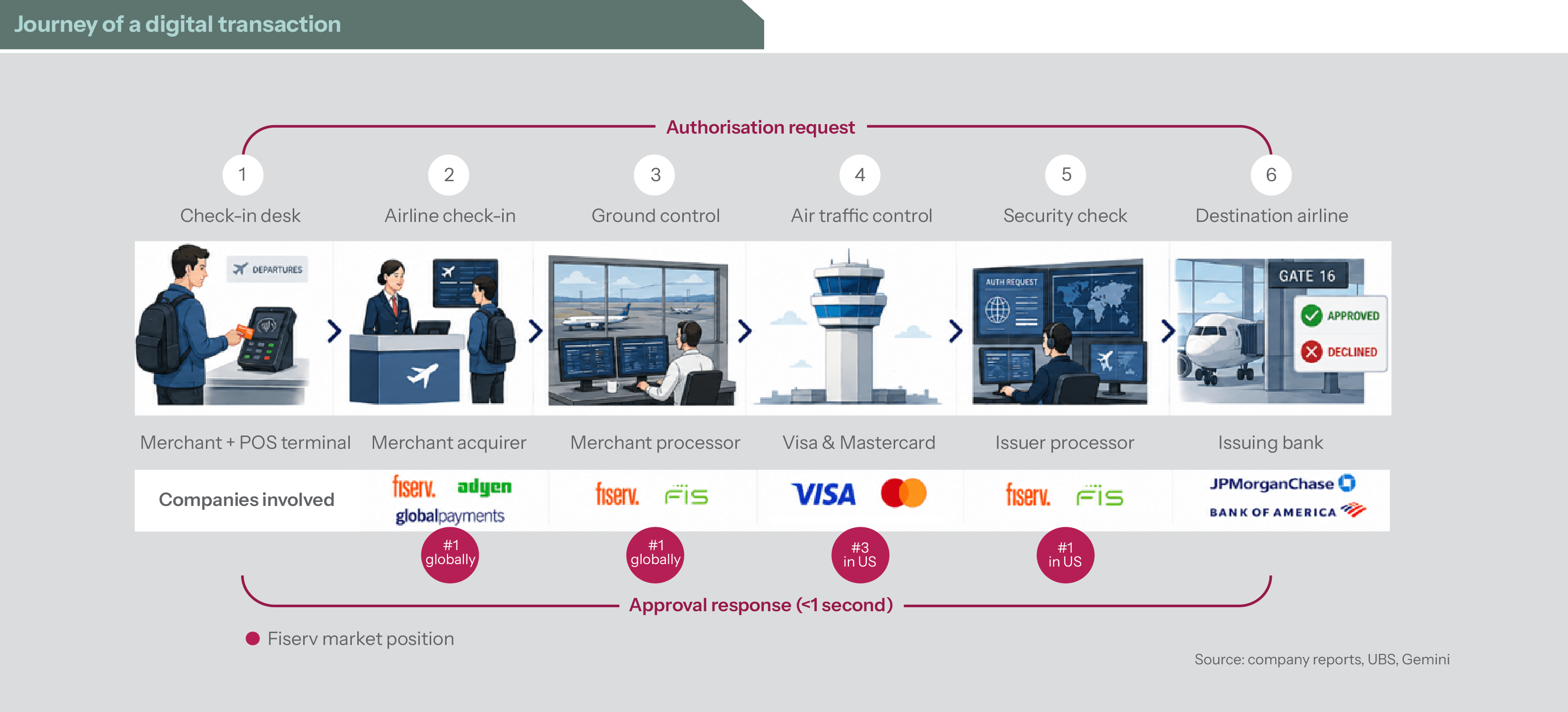
When a customer taps their card, the payment terminal acts like an airport check-in desk, initiating the payment. The request flows to the merchant acquirer, which enables card acceptance, before the payment processor verifies the information and routes the transaction. Visa or Mastercard (predominantly, but also Fiserv) then provide the network connecting all participants, while the card issuing processor performs fraud and security checks. Finally, the customer’s bank (like the airline) makes the approval decision based on available funds and credit limits - as illustrated below.
Fiserv generates roughly half of its revenue from banks by providing the software and payment infrastructure used to manage customer accounts, process payments and deliver digital banking services. The other half comes from enabling merchants to accept card payments, process transactions and receive funds. Although invisible to consumers, Fiserv is deeply embedded in the financial system, enabling the authorisation, processing and settlement of millions of transactions across the globe.
Embedded in a fragmented US banking system
Fiserv began by providing core processing software to the highly fragmented US banking industry, where interstate branching restrictions left thousands of regional banks without the scale to develop complex technology, cybersecurity and compliance capabilities in-house. These banks rely on Fiserv’s systems to authorise transactions, update customer records and monitor fraud in real time – making it difficult and operationally risky to consider changing providers.
As banks grow, Fiserv benefits from higher transaction volumes processed on its platforms and from increasing product adoption among existing clients. The result is a mostly recurring revenue stream on a low fixed cost base, which enables high incremental profit margins. However, Fiserv’s banking software business growth is structurally constrained by infrequent core system replacements, tight bank technology budgets and industry consolidation, which reduces the addressable customer base. Nonetheless, these bank client relationships provide a valuable distribution platform for Fiserv’s merchant acquiring business, which has become the company’s fastest-growing segment.
A four-leaf growth story
Consider the coffee shop owner processing dozens of card transactions every day. Fiserv’s flagship Clover product bundles point-of-sale hardware with a rich software layer that handles inventory tracking, staff scheduling, customer loyalty programs and real-time sales analytics - all from a single device. For a small business owner, this replaces a patchwork of unconnected tools with one seamless ecosystem, resulting in a deep, valuable relationship with Fiserv.
Today, Fiserv operates the third-largest debit network in the US and touches more than 95% of household transactions via its software. The financial model produces increasing returns to scale because additional payment volumes can be delivered via existing infrastructure at low incremental cost. The company uses existing relationships with banks, software partners and reseller networks to reach new merchants, giving Clover lower-cost routes to market than competitors, who depend only on direct sales.
While Clover has become the primary contributor to Fiserv’s growth, it represents only one part of Fiserv’s broader Merchant Solutions platform. The company also serves larger enterprise merchants and continues to invest in the technology underpinning the platform, broadening its product offering and improving efficiency. This gives Fiserv multiple avenues to grow, by expanding its merchant base and increasing the value of existing customer relationships through additional payment and software services.
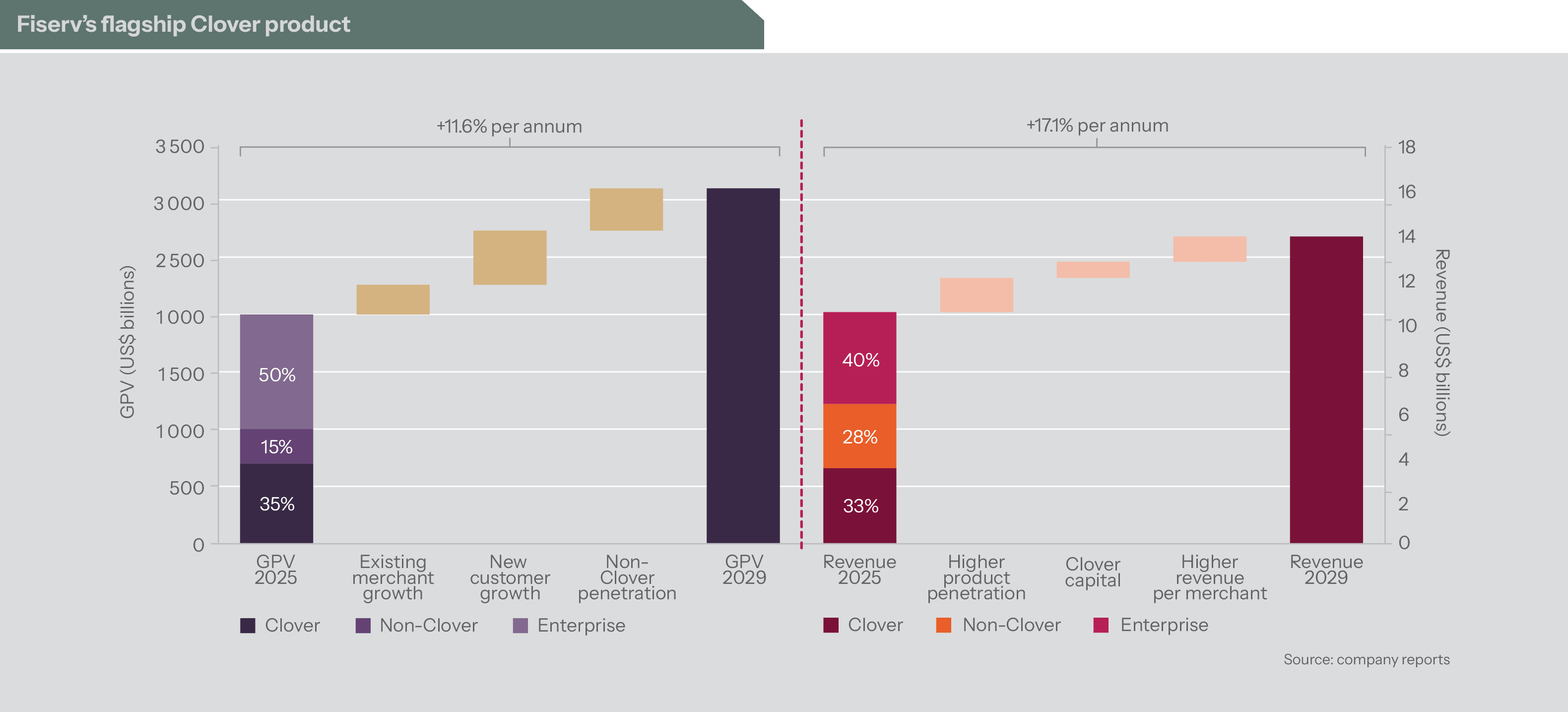
Management’s growth targets for the segment, shown below, outline a clear path from roughly $2 trillion in total payments processed (GPV) today to over $3 trillion by 2029. They are targeting 10-15% per annum medium-term growth through three levers: volume growth from existing merchants, adding new merchants to the platform and converting the remaining 60% of Fiserv's legacy customer base to the Clover platform.
Revenue is expected to grow faster, at 15-20% per annum, as merchant adoption of value-added software (like lending product Clover Capital) rises and businesses increase their use of payment volume-related services. This allows Fiserv to capture a larger share of each customer relationship without relying solely on higher transaction volumes and provide a pathway to faster revenue growth and margin expansion.
Multi-decade compounder trading at a valuation discount
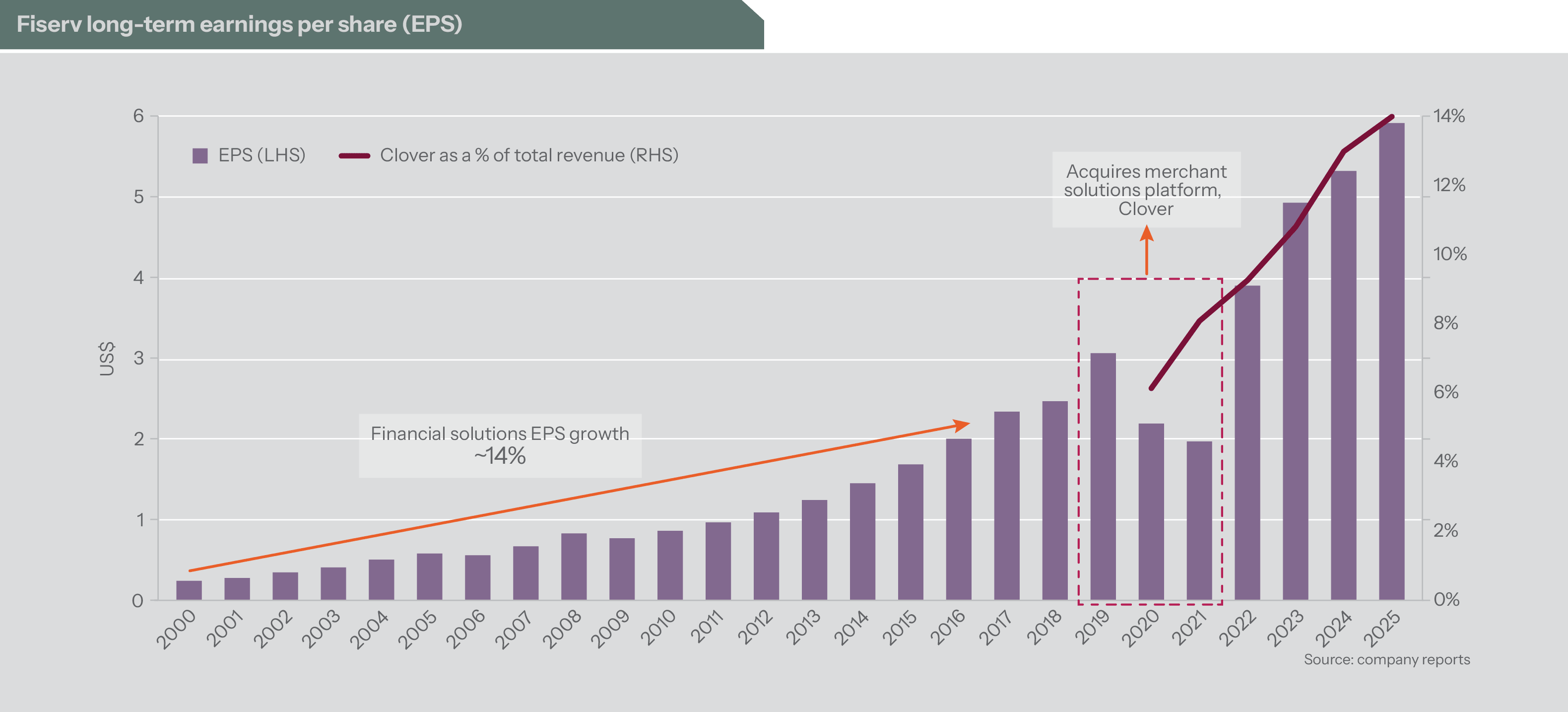
As charted below, Fiserv has compounded earnings per share at an impressive double-digit rate for more than two decades. Until 2019, this growth track record was built on the back of the banking software business. Since the launch of Clover, the merchant business has become Fiserv’s primary source of growth. Clover’s contribution to group revenue has more than tripled over the past five years but still represents only a fraction of total revenue. With a large existing merchant base still to migrate, further customer wins and greater Clover software adoption, the platform is well positioned to become a significantly larger part of Fiserv over time.
Fiserv’s technology is mission-critical to the daily operations of thousands of financial institutions and millions of merchants. This dual positioning creates high switching costs and gives the company cross-selling and data advantages that stand-alone competitors cannot replicate. The software-based business model is highly capital efficient, requiring limited ongoing investment to scale. As a result, a high proportion of earnings converts into free cash flow, supporting continued investment in the business while also allowing Fiserv to return capital to shareholders.
More recently, execution missteps and the sudden departure of the newly appointed CEO weighed heavily on sentiment, resulting in a significant share price decline. At current levels, Fiserv trades at a share price that deeply underestimates the durability of its recurring revenue base, the potential to scale the Clover platform and the secular tailwinds supporting digital payments growth.
Like an airport, the payments system only works because critical infrastructure operates reliably behind the scenes. Over decades, Fiserv has built a unique position within this network, combining entrenched banking relationships with a scaled merchant platform, a highly recurring revenue base and robust cash generation.
We believe this disconnect presents an attractive opportunity to own a business with a proven track record, significant scale and competitive advantages in payments software. Our global fund clients therefore hold Fiserv.