
Disney's timeless content

Disney’s theme parks, products and streaming platforms may be its most visible businesses, but they all earn from the same source: its content. By owning some of the world’s most valuable stories and characters, Disney can continue generating revenue from the same content through films, sequels, spin-offs, streaming, parks and merchandise for decades to come. We explore why, however audiences choose to engage with Disney’s content, the value it generates should continue to grow.
A library for every age
Most people associate Disney with its classic characters and enduring stories that are an integral part of popular culture. Fewer realise that Pixar, Marvel and Star Wars are also part of Disney. Together, they form one of the world’s most valuable collections of characters and media franchises. Disney owns 7 of the 10 highest-grossing films ever made across Marvel, Pixar, Lucasfilm and its own studios, each serving a different audience.
The original studio, Walt Disney Studios, produces family films built around characters that resonate with children and adults alike. These characters create demand for toys and attract families to Disney’s parks. After Frozen was released in 2014, Elsa dresses sold out worldwide and the film's merchandise generated around $10 billion in global retail sales. As with most licensed merchandise, Disney received only a fraction of those revenues, with the majority going to toymakers and retailers – a model that continues to apply today. The 2002 film Lilo & Stitch generated over $4 billion in retail sales of Stitch merchandise in 2025, boosted by that year's live-action remake.
Pixar specialises in computer-animated films, with broad, cross-generational appeal. Since 1995, the Toy Story franchise has earned more than $3 billion at the box office, with a fifth film in the franchise opening in 2026 - 31 years after the first.
Marvel produces superhero films aimed primarily at teenage and adult audiences. Its films have collectively earned over $30 billion at the box office - the highest total of any film franchise - while also encouraging demand for action figures and collectibles. Avengers: Endgame grossed $2.7 billion, the second-highest grossing film of all time.
Lucasfilm’s science-fiction franchises have a loyal fan base and generate revenue through collectibles and theme-park attractions. The Mandalorian introduced the character Grogu, whose merchandise has generated around $1 billion in annual retail sales since launch. Grogu demonstrated that a character created for streaming can be just as commercially successful as one originating from a feature film.
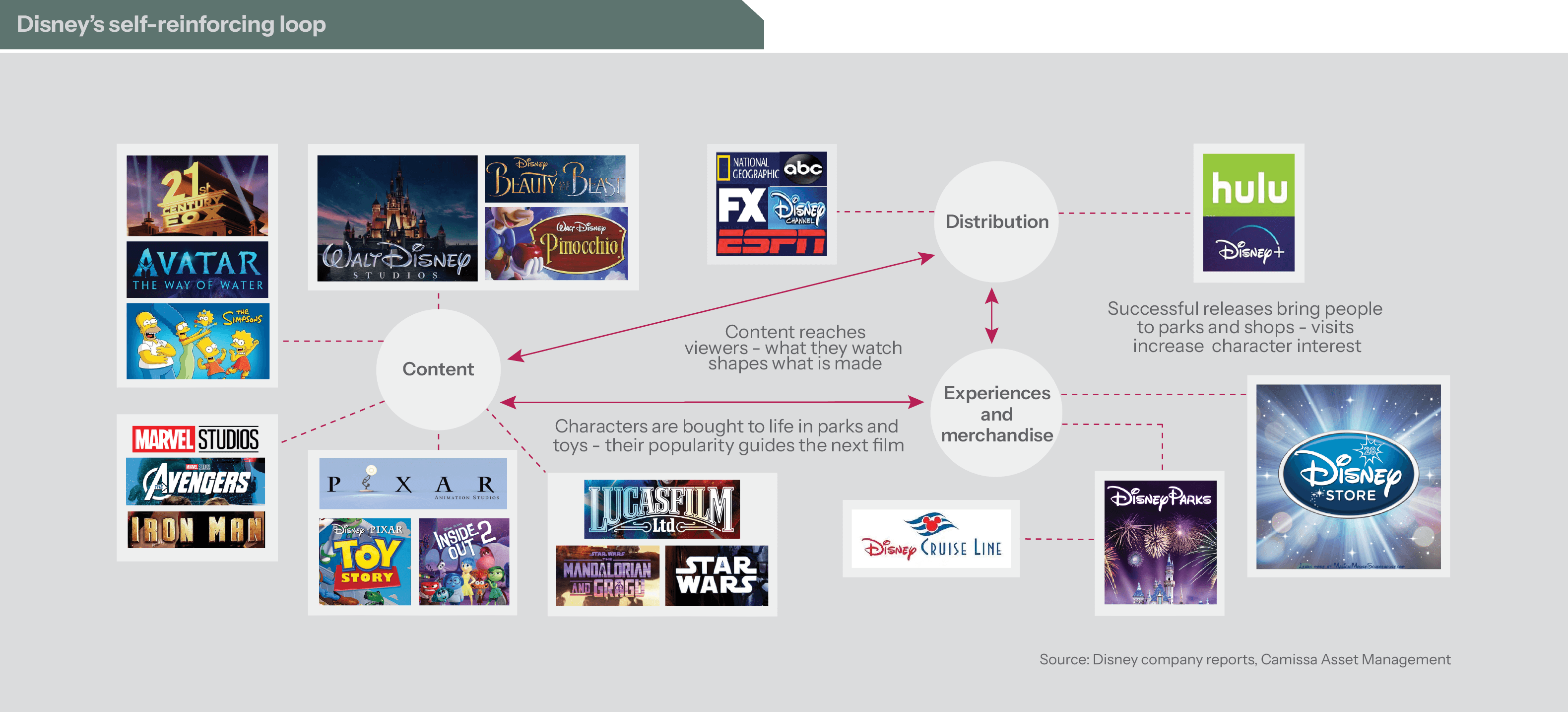
Reliance on familiar characters, however, carries the risk of franchise fatigue. Marvel is the clearest example, with recent films drawing far smaller audiences than at the studio’s peak, following years of frequent releases. Disney’s broad content library serves different audiences and reduces its reliance on any single franchise - while one may weaken, others continue to generate revenue. The model has run for almost a century, through repeated shifts in technology and character popularity cycles. The chart below shows how these characters reinforce one another across films, parks and merchandise, which is what makes the library durable.
The shift that costs Disney less
Disney’s catalogue remains valuable because audiences continue to return to the characters they grew up with and new generations of children are introduced to old favourites. What has changed though is how the content is consumed, with streaming increasingly replacing cable television and reducing cinema attendance.
Cable television was once a reliable source of income for Disney. Operators paid a fee for every subscribing household. Its sports network, ESPN, carries high broadcasting costs, but the bundled cable model spread these costs across all subscribers, whether they watched sport or not. As cable subscriptions decline, that advantage is disappearing. Sold as a standalone service, ESPN must recover those costs from sports viewers alone, requiring higher prices against more uncertain demand.
Providing a streaming service carries significant upfront investment to build the platform to deliver a high-quality viewing experience and the content to attract subscribers. However, the cost of producing a film or show is largely fixed, so additional viewers add little incremental cost. Each new subscriber therefore contributes proportionally more to profit, making streaming increasingly profitable at scale. Disney entered streaming with a deep catalogue and known franchises, which let it build a large subscriber base fast and achieve long-term client retention. It operates two complementary services: Disney+ for its films and franchises, and Hulu for general entertainment.
Disney can also move content between cinema and streaming. A successful cinematic release attracts subscribers to Disney+, who would otherwise require costly marketing spend to acquire. In late 2024, Deadpool & Wolverine grossed $1.33 billion at the box office. In the same quarter, Disney+ added 4.4 million subscribers, with most joining the lower-priced, ad-supported tier.
The relationship also works in reverse. Characters established on Disney+ can be developed into feature films at lower risk as the audience already exists. The 2026 Mandalorian and Grogu film cost around $166 million, well below the $245-$317 million spent on Disney’s Star Wars trilogy. This ability to build audiences across cinema and streaming is an advantage few competitors can replicate.
The lower-priced, ad-supported tier improves the economics of streaming. Subscribers pay a monthly fee while also generating advertising revenue from the content they watch. Because the content has already been produced, much of the additional advertising income flows directly to profit for Disney. As more subscribers choose this tier, advertising becomes a growing share of what streaming earns.
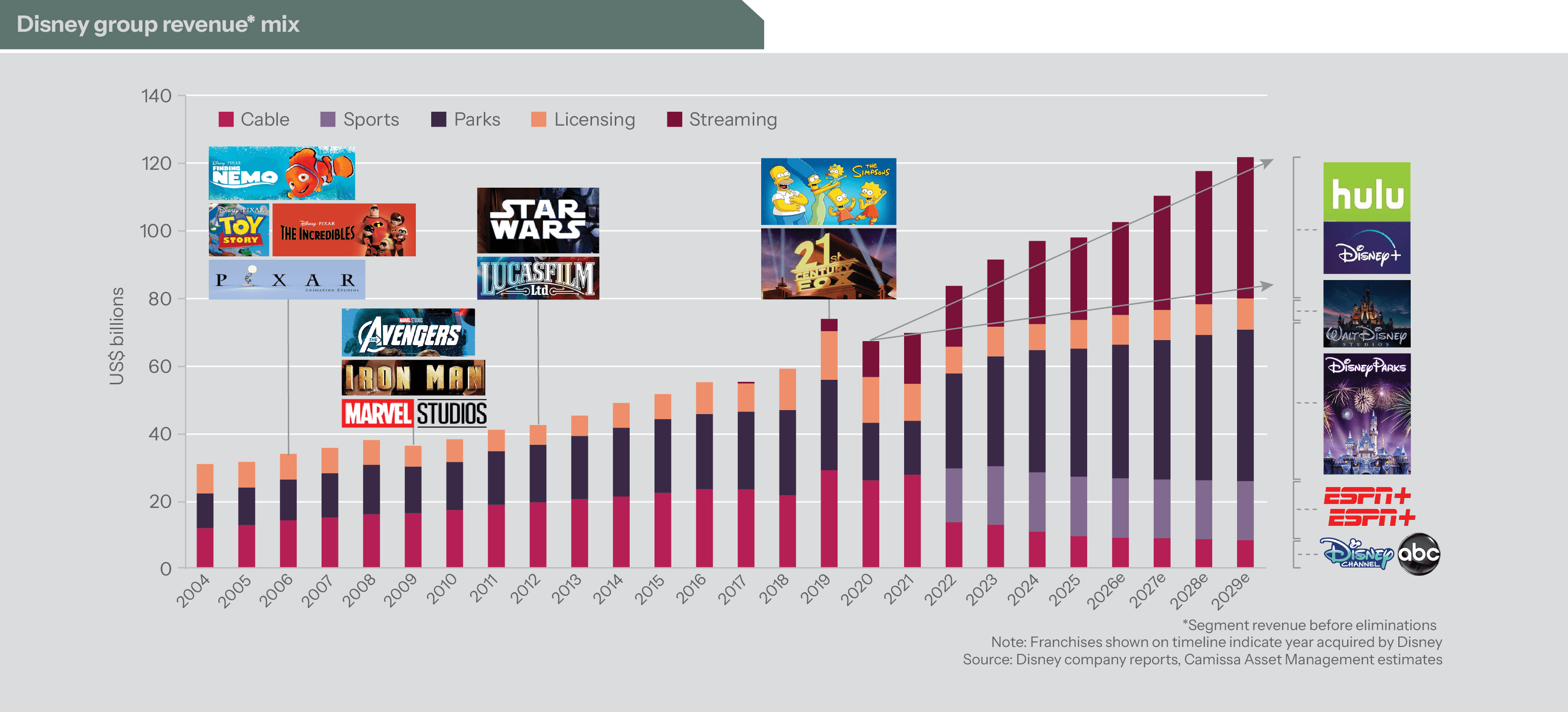
Disney’s broader content library improves subscriber retention. Its franchises attract viewers, while Hulu’s general entertainment gives them reasons to stay between major releases. Retaining subscribers costs less than acquiring new ones, therefore the longer they remain on the platform, the more profitable they become. Disney’s revenue mix has shifted from cable towards streaming, even as the total has continued to grow. This is illustrated below, with the logos on the right showing which brands sit in each part of the business. Sports appears as a separate line item only from 2022, when Disney began reporting it outside of the cable bundle.
Where Disney earns the most
Disney earns regardless of how audiences choose to consume its content, yet the highest returns come from bringing its characters into the physical world. The Experiences division is Disney’s most profitable, generating revenue through theme parks, hotels and merchandise. Reflecting its strong profitability, Disney plans to increase investment in the division by approximately $60 billion over the next decade - equal to around $6 billion annually - up from a historical $3.5-$4 billion. Most of this will go towards expanding existing parks, from new themed areas such as Villains Land in Orlando to the doubling of Disneyland Paris. The remainder will fund growth in the Cruise business.
Disney’s US theme parks are operating close to capacity. With limited scope to increase visitor numbers, future growth will come from higher spending per guest rather than larger crowds. Spend per guest has risen to around 60% above pre-COVID levels, as Disney has begun charging for services it once provided for free, increased prices on peak days, and used its mobile app to boost food and merchandise sales.
Disney’s cruise fleet is expected to grow from 8 ships to 13 by 2031. The company is also using cruises to enter new markets, with the Singapore-based Disney Adventure opening access to Southeast Asia. Even as capacity expands, occupancy has remained near prior-year levels, indicating demand has kept pace with growth. Within the cruise industry, Disney benefits from scale, lower costs per passenger and higher onboard spending than all-inclusive boutique operators, delivering strong ship-level economics. That said, cruises still earn lower margins than the parks, so as their share of Experiences grows, they modestly dilute the segment’s blended margin in the near term.
A lasting advantage
Disney’s ownership of its characters remains the source of its strength. Whether audiences choose cinemas, streaming, theme parks or products, Disney can continue earning from the same stories across multiple channels at little extra cost. Franchise fatigue and the decline of cable are real risks, but the breadth of Disney’s library reduces its reliance on any single franchise or distribution channel. As audiences embrace new ways to engage with content, we believe Disney will continue to extract greater value from its content. Our global fund clients hold Disney as we believe its share price vastly undervalues its strong prospects.